AI-powered fraud detection in workers compensation insurance
AI‑powered fraud detection helps Australian workers compensation insurers triage claims faster and more consistently by applying targeted, explainable risk checks early. This reduces manual effort, supports human decision‑making and speeds up outcomes for genuine claims while helping insurers control costs.
April 09, 2026
Insights

AI-powered fraud detection is supercharging workers compensation insurers to identify suspicious activity faster, reduce losses and improve the experience of genuine customers.
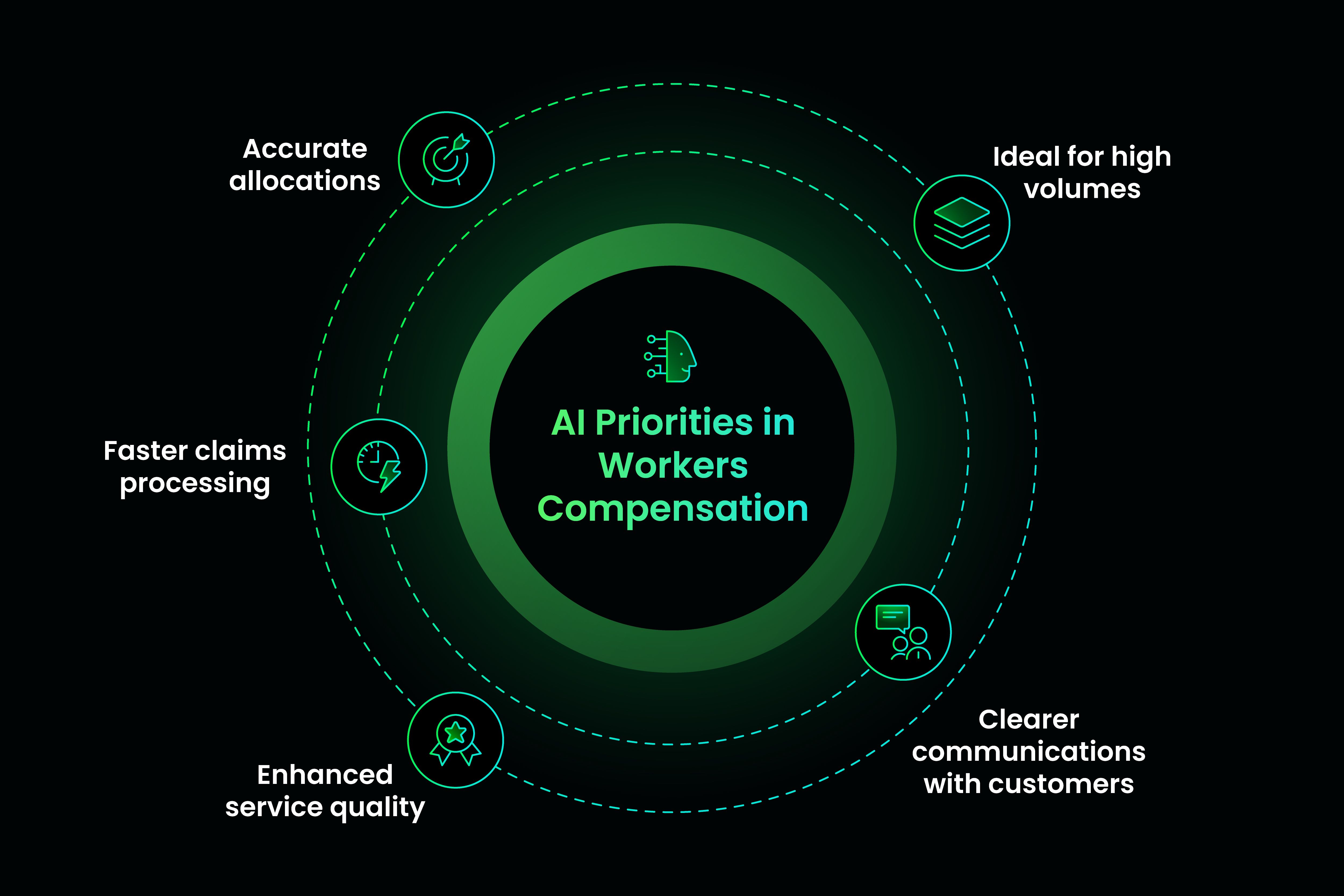
In Australia, where workers compensation and other liability insurers face high claim volumes, document‑heavy assessments, and mounting cost pressures, the primary value of AI lies not only in detecting fraud but in improving the speed, consistency, and accuracy of claims processing overall. Industry research from CSIRO and the Insurance Council of Australia highlights AI’s role in streamlining claims triage and decision support, while Australian insurers report efficiency gains as claim volumes continue to rise. Fraud detection and prevention was identified as the second highest AI adoption priority after automating claims processing and triage with key opportunities that included:
- Faster claims processing
- Accurate allocations
- Clearer communications with customers
- Enhanced service quality
- Ideal for high volumes
In the last decade, serious worker injury claims have increased by 34.5% and as claim volumes grow, manual document reviews and step‑by‑step checks can slow the overall claims journey. AI‑enabled claims processes help ease this pressure by automating document collection and upfront fraud screening, improving throughput and accuracy while enabling claims professionals to focus on judgement‑based decisions.
By applying the same policy rules and risk indicators at the point of triage, AI creates a scalable and consistent baseline before claims are reviewed by people. This reduces manual rework and accelerates assessment, allowing claims teams to focus on complexities that require a human touchpoint.
Australian insurers are increasingly using AI in this way, to surface patterns and prioritise investigations at scale, while keeping final judgement with human reviewers and improving reliability without removing human oversight.
Where customers benefit from AI fraud detection
When fraud checks in workers compensation are more targeted, genuine claims are less likely to be caught up in in-depth manual reviews. This leads to faster decisions, quicker access to treatment and income support, and fewer repetitive requests for the same information.
AI also helps when claim volumes spike, such as during or large workplace incidents that generate many similar claims at once. By quickly separating straightforward, low-risk claims from those that show unusual patterns in injury type, treatment, or return‑to‑work behaviour, AI reduces friction for employers, injured workers, and case managers.
Why it matters in Australia
Workers compensation in Australia sits within a complex, highly regulated framework that varies by state and territory, with strict obligations around decision timeframes, worker protections, and dispute resolution.
AI-powered fraud detection helps schemes and insurers meet these obligations by providing consistent, explainable risk scores and clear escalation paths for potential misconduct or abuse of the system.
AI can apply a consistent view of risk across jurisdictions while still accommodating state legislation, making it easier to identify unusual claim patterns, treatment behaviours, or employer practices wherever they occur in Australia.
Main business outcomes
For insurers, the financial case is strong. AI can reduce claims leakage by catching fraud before claims are approved.
It can also reduce investigation costs. Instead of manually checking every file, fraud teams can use AI to narrow the field and concentrate on the highest-risk claims. That improves productivity and can reduce the need for extra headcount during peak periods.
There is also a strategic benefit. Insurers that use AI well can respond more quickly to changing fraud tactics. As fraud patterns evolve, models can be retrained and updated, which makes the fraud program more adaptive than a fixed rule set.
Technology benefits
AI fraud detection is effective because it can combine several kinds of analysis at once. Machine learning can identify patterns in historical claims, anomaly detection can spot outliers, natural language processing can analyse claim descriptions and notes, and image analysis can review submitted documents or photos for inconsistencies.
That multi-layered approach is more powerful than traditional rule-based systems. Rules can only detect what someone has already thought to look for, while AI can find new combinations of signals that may not have been obvious before.
AI can also support real-time or near-real-time triage. That is a major operational advantage because it allows insurers to assess risk earlier in the claims process, rather than discovering concerns only after payment or during a post-settlement audit.
Operational challenges
The main challenge is false positives. If a model flags too many legitimate claims, it can create unnecessary delays and hurt customer trust. That is why insurers need to tune their systems carefully and keep humans involved in final decisions.
AI systems depend on clean, complete, and well-labelled data. If the underlying claims data is messy or inconsistent, the model may miss important signals or flag the wrong files.
Explainability is also important. Insurers need to be able to explain why a claim was flagged and what factors influenced that decision. That matters for governance, regulatory expectations, and internal confidence in the system.
Tiimely for workers compensation
Tiimely is built to help workers compensation insurers move faster, make better decisions, and improve the claims experience without adding more manual workload. Its platform is designed around explainable automation.
For insurers looking to lift performance across claims and fraud workflows, Tiimely offers a practical path into AI-enabled operations. Making claims teams sharper, faster, and more scalable in the real world.
Related articles

Insights
Embedded Finance and AI Integration. ‘AI out of the box’ - Efficient and relevant diversification
Tania DeMasiMay 22, 2025

Insights
AI products and services: The next frontier for the financial industry.
Tania De MasiJul 16, 2025

FAQ
Xapii FAQ - Full customisation with Kayla Sommer
TiimelyJul 18, 2025