Your bottleneck isn't headcount. It's process
Many organisations feel the pressure to scale their workforce. It can come from a desire to increase volume but face complex regulations and a customer base expecting faster and more transparent experiences.
April 24, 2026
Insights

Many organisations feel the pressure to scale their workforce. It can come from a desire to increase volume but face complex regulations and a customer base expecting faster and more transparent experiences. Yet headcount is a consideration that bears the weight of significant discussion at the highest levels of any business. It’s a fair and reasonable conversation to have, headcount means cost.
A natural response is to push harder. Tighten SLA’s, redistribute workload, optimise rostering. But that isn’t scale. It’s compression.
True scale happens when performance increases are enabled without doubling efforts at the same rate. It’s about removing friction from the system so that doing more doesn’t require people to work longer or carry greater cognitive load. In lending and credit environments especially, inefficiencies compound quickly either through manual data handling, repetitive verification, policy interpretation at the point of assessment, and rework driven by any number of issues.
At a macro level, we’re seeing the economic impact of friction reduction becoming more widely understood. The Digital Finance Cooperative Research Centre estimates Australia could unlock $24 billion per year, equal to around 1% of GDP, through digital finance innovation.
Those gains are attributed to:
- Reduced transaction and settlement costs
- Improved capital and collateral efficiency
- Streamlined compliance
- Lower operational overheads.
When systems remove friction, productivity follows.
How sovereign AI is shaping lending automation
The same conversation is now extending beyond productivity to capability and control. Sovereign AI, where a country and the companies operating within it design, train and deploy AI under their own laws, on infrastructure they control, using locally governed data, is quickly becoming a boardroom issue.
More than 8 in 10 organisations (83%) view sovereign AI as at least moderately important to their strategic planning, and 43% rate it as very or extremely important.
This matters because scaling through AI and automation isn’t simply about speed. It’s about trust, governance and resilience. Deloitte recently noted that worker access to AI rose by 50% in 2025, and the number of companies with at least 40% of AI projects in production is set to double within six months. Expectations for scale are high but so is scrutiny which extends to more than just where models are built. It’s whether the right kind of AI is being applied to the right functions.
In highly regulated sectors such as credit services, for example, models must support audibility, legal defensibility and customer rights; using opaque or overly complex AI systems without appropriate safeguards is increasingly a regulatory concern. ASIC’s market study REP 798 underscored this point, warning that many financial and credit licensees are adopting AI faster than they are updating their governance and risk framework.
The differentiator will be whether AI and automation genuinely reduce operational burden or simply layer additional oversight onto already stretched teams.
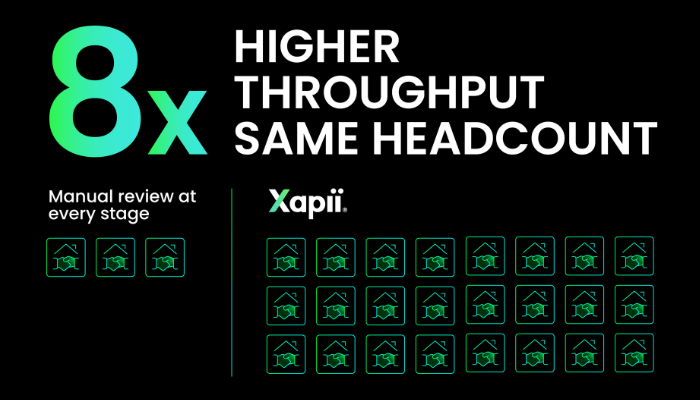
At the enterprise level, the same logic applies. Embedding policy directly into systems rather than relying on manual interpretation creates consistency. Automating the flow of straightforward scenarios allows teams to focus on complexity. Designing for exception-based underwriting ensures human expertise is applied where it adds value, rather than spread thinly across every file. Performance improves not because people are working harder, but because the system is working smarter.
Implementing automation into your lending process
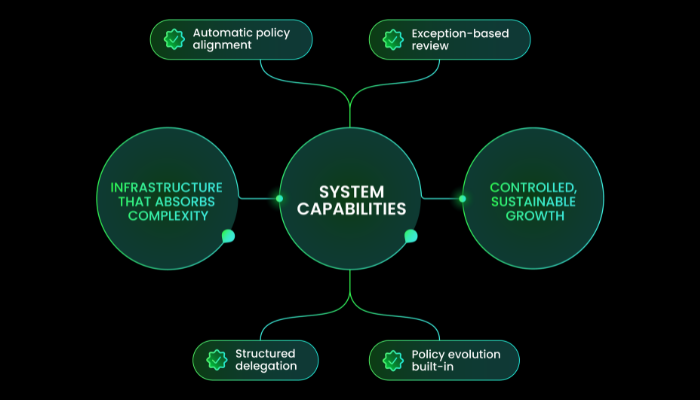
Scaling without adding headcount ultimately requires infrastructure that absorbs complexity. Systems need to align to credit policy automatically, support structured delegation frameworks, adapt as policy evolves, and surface exceptions rather than forcing blanket manual review. When that foundation is in place, growth becomes controlled and sustainable rather than reactive.
If this feels familiar - if growth is constrained less by demand and more by operational capacity, it may be a signal that the bottleneck isn’t people, but process.
Platforms like Xapii by Tiimely are built around that principle: embed policy into the workflow, consolidate and enrich data in real time, automate what can be automated, and elevate only what truly requires judgement.
The organisations that scale sustainably won’t be those with the largest teams. They’ll be the ones that have removed the most friction. Scaling without adding headcount ultimately requires infrastructure that absorbs complexity.
Systems need to align to credit policy automatically, support structured delegation frameworks, adapt as policy evolves, and surface exceptions rather than forcing blanket manual review.